Loading component...
At a glance
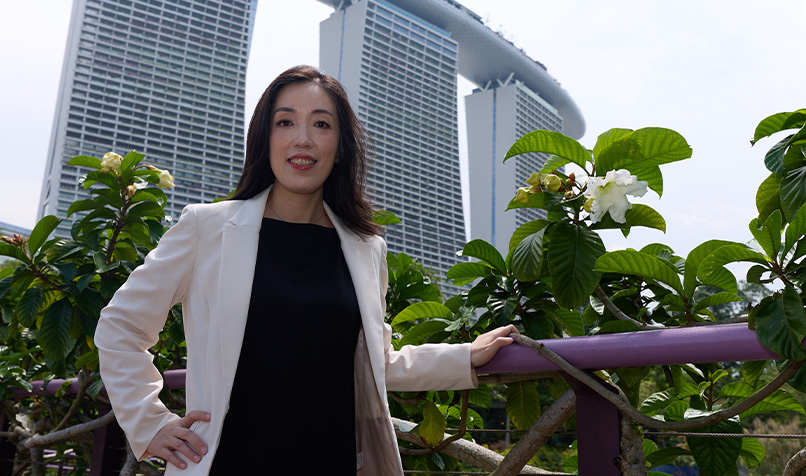
- Shelly Shi FCPA is the APAC CFO for global manufacturer, Ravago, and runs a team of around 120 across the region.
- Shi maintains that numbers are the easiest part of her role and she is equally focused on growth and new tech solutions.
- She believes the key to “people challenges” in any organisation is to ask the right questions and press “the right button”.
By Johanna Leggett
My role: Thinking beyond the numbers
I am based in Singapore, a region that is dynamic, diverse and full of opportunity. Ravago is a family-owned global materials group focused on polymers, chemicals and building materials, operating across distribution, resale, manufacturing and recycling. We have 58,000-plus active customers and operations in more than 60 countries.
I manage a sizeable team in APAC, so the role is broad. It is not only about finance in the traditional sense, but also about understanding what is happening across the business and making sure the teams are able to move forward.
Most people assume that my role is all about the numbers, but numbers are only one part of the job and, I would argue, the easiest part. My day typically starts with thinking about growth, people and process.
I spend a lot of time talking to my colleagues in order to understand what is happening on the ground. The numbers give me visibility into how the business operates, but, in reality, being a leader is really about helping people and the business become better than they are today.
My job involves a lot of decision-making, managing expectations and helping different teams work together. I think every growing organisation is facing people challenges: finding the right people, putting them in the right positions and motivating them. I believe that you have to “press the right button” to help people to work happily.
My one-on-one conversations start with “How do you feel today?”, “Are you happy working here?”, “What are your challenges?” and “How can I help you?” I believe it is important for everyone to find the right balance between personal achievement and contribution to the company.
Once you find that sweet spot, you get the most out of people, and they can really contribute and bring growth to the business. Of course, it is not without its challenges. People are the most complicated subject that every leader deals with, and it is no different for finance leaders.
But I am proud of the strong team I have built. I am always very proud whenever I catch up with them.
AI Risk Management for Accountants
Game changers: Being brave
My pivot point was being brave enough to leave Sealed Air, a company I had worked with for over a decade, to join Ravago, which is a more entrepreneurial family-owned business. The decision was not just professional but also personal, because I became more conscious about taking ownership of my career and what kind of leader I want to be.
I started my finance journey in an unconventional way. I studied law and sociology in university, so I was not academically trained as an accountant from the start. Of course, when I joined KPMG early in my career I went through intensive training, starting at debit and credit, preparing financial statements, compliance and so on.
From that point my career route became quite traditional. I spent three years in an audit firm, moved into corporate, and my roles progressed conventionally from there.
I spent a short period of time at Apple, but realised that while it was a good job and a nice company, it was not for me.
"You must find the right balance between personal achievement and contribution to the company. Once you find that sweet spot, you get the most out of people, and they can really contribute and bring growth to the business."
What drove the decision to leave Sealed Air was the realisation that while working in a US company was more structured with a lot of governance frameworks, you are not as close to the action. I was really interested in getting closer to the business, and I wanted to make more impact.
Being in the farthest region of a US-listed company, there are a lot of decisions that need to be made from the US headquarters, which is far from the target market and the customers.
At Ravago, I am much closer to the core of the business, the people and the market, and the leadership team gives us a lot of authority and autonomy to make decisions.
I think taking ownership of my career was at the heart of my development: it meant being honest with myself and looking for a meaningful next step.
5 ways to track the ROI of AI
My challenges: Working smarter
Meeting supply and demand, managing expectations and helping the business operate in a fast-moving and competitive environment are daily challenges for me.
However, the one that keeps me awake at night is how to utilise technology and artificial intelligence (AI) to help my team work more efficiently.
In Singapore, there is a lot of emphasis on utilising technology to make people more productive and efficient. In a region where we have powerhouses like China, India and South-East Asian countries, we have a lot of tools that we can leverage.
So, for me, the question is really about how to best cope with today’s fast-moving and competitive environment in a smarter way. As an example of where technology can be leveraged at Ravago, take my operations team.
They are dealing with calls from salespeople and customers asking, “Where are my goods and when can they be delivered?” They have to put down what they are doing, go into the system to see where the goods are and their status, then also look through emails to see whether anything has happened in-between.
I think about whether we can use technology to send a message to customers when their order is dispatched, just like you would receive when you order from a retailer.
In those cases, you receive updates that your order is being prepared, when it is on the way and when you will receive it. This is one simple example, but it shows how we can potentially save the team time so they are not spending hours answering queries and can instead focus on more critical issues.
The other major challenge is the nature of the sector itself. When there is a crisis, our product becomes very popular because many companies need polymer resins. But we have to prepare for when the wave retreats, when prices become lower and the margin is thin. That is why gaining efficiencies will give us built-in margin, because a business has a lot of fixed running costs.
When the rainy days come, relying on umbrellas is not enough. You have to find a way to make the team lean now — even if it is not raining yet.
Preparing for the future is always a challenge. I think it is about finding pockets of growth, especially in this region that is so competitive, and looking at how we can be ready to seize new growth areas and opportunities.
For me, that is where the CFO role is crucial: in not just managing supply, demand and expectations, but helping the business become more effective, more forward-looking and ready for what comes next.
Lessons learned
- Think beyond the numbers: Getting the numbers right matters, but the real value comes from what sits behind them — the insight and direction you can give the business.
- Take ownership of your career: Do not wait for someone else to map your path. You need to speak up, raise your hand for projects and be brave enough to step out of your comfort zone.
- Commit to continuous learning: However busy work gets, keep making time to learn. AI and technology may automate parts of your work, but your learning capabilities cannot be taken.