How robotics could reshape Australian business productivity


Loading component...
At a glance
- Australia has strong robotics expertise that could elevate the technology from niche use to core economic infrastructure and boost productivity, innovation and competitiveness nationwide.
- Falling robot costs and robotics-as-a-service models are making adoption easier, but finance leaders must evaluate ROI, risks and governance to invest responsibly.
- Boosting procurement, improving supply chains and leveraging strengths in field robotics and remote environments will strengthen the robotics ecosystem.
Australia has been building world-class robotics capability for decades. From Rio Tinto’s colossal autonomous trains — some of the world’s largest robots — to cutting-edge field robots, the nation has quietly become one of the world’s most experienced operators of large-scale autonomous systems.
Now, as machines continue to move from the mine site into everyday business operations, a bigger opportunity is emerging: for finance leaders willing to think beyond automation, robotics is capable of lifting productivity, unlocking new revenue and reshaping the future of industry.
To appreciate the potential of the Australian robotics industry, it is important to understand that robots can do more than replace human work. The country has an opportunity to move from viewing robotics as a niche technology to positioning it as vital economic infrastructure.
“We have had industrial robotics since the 1960s — for example, large robot arms on factory floors that might help with building a car,” says University of NSW Artificial Intelligence (AI) Institute director, Dr Sue Keay. “Australia is strong in field robotics, which is a type of service robot you mainly find outside.
There are also around 1000 autonomous load-haulage vehicles operating mainly in West Australian iron ore mines. They are very big, self-driving trucks, but they are a form of robot.”
With this pedigree, Australia already produces the robotics of the future.
“We are moving away from static robots from the industrial era, kept separate from humans to safely operate, into this more dynamic environment,” Keay continues.
“Robots are now moving around and they have to be able to make decisions in real time. Increasingly, they also must operate safely side-by-side with humans.”
For Australia to build up its robotics ecosystem, governments and major businesses need to buy from emerging robotics companies to build the local industry.
Robots in the finance team
Finance leaders need to take a considered view of what robotics means for their operations. Capital allocation, cost structures, procurement models, workforce planning, risk management and performance measurement are just a few things to consider.

“There are lots of ways we can use this technology,” says David Howard, group leader for robotic design and interaction at the Commonwealth Scientific and Industrial Research Organisation (CSIRO). “But for it to function in an economy, it needs to have that ROI piece to it.
“Robots do not cost A$250,000 anymore. They cost A$25,000, and when a robot costs A$25,000, it is more palatable as an investment,” Howard explains. “We are seeing these robots turn up in lots of different places, and businesses are trying them out and seeing how they fit into a workflow.
But bear in mind what the robots are good at and do not get sucked into the hype, especially when making investment decisions.”
Australia’s National Robotics Strategy is the architecture for the nation’s approach to robotics. “It is an important north star, but it still needs to be operationalised and that is what CSIRO is doing,” says Howard.
When finance executives are thinking through the role robots can play in a business, a cited limitation is that they are not adept at interacting with humans. Howard points to Moravec’s paradox, which suggests the things that are hard for a human to do are easy for a robot to do, and vice versa.
“It is easy for a robot to do something like a precise dance routine that would take someone years to train for. But when robots are asked to do simple tasks like fold a T-shirt and interact with the world, something most humans find easy, they often fail.
Humanoids cannot do too much interaction at the moment. If we can get humanoids with good hands, then we might be talking,” he says.
More importantly, robotics investment needs to move beyond use cases that emphasise labour replacement.
“We need to progress from experimental innovation budgets into mainstream capital allocation and operational planning,” says Jannat Maqbool FCPA, business development manager at the Australian Urban Research Infrastructure Network, University of Melbourne.
“This involves identifying the highest-value automation opportunities. Accounting and finance professionals should be helping businesses move beyond hype into disciplined investment, risk management and value creation.”
Critically, robotics procurement is unlike traditional equipment procurement.
With robotics, procurement must combine hardware, software, AI, cybersecurity, data governance, maintenance, workforce training, vendor management, insurance and safety compliance. This means workforce planning must be built into the investment case from the beginning.
A mindset where robotics is seen as part of sustainable growth should be the foundation of any change management program around robotics’ introduction.
AI Tools for Accountants
Day-to-day integrations
There are many entry points for businesses that are interested in exploring robotics.
One such model is robotics-as-a-service: instead of buying robots outright, businesses pay a subscription or usage fee for access to robotic capability, often bundled with maintenance, software updates, monitoring and support.
“This is especially useful for small and medium enterprises that may not have the capital or technical capability to own and maintain robotics infrastructure,” says Maqbool, who is also a member of CPA Australia’s Digital Transformation Centre of Excellence.
As with AI, it is essential to properly manage data created by robots, which is considered an intangible asset. “That data can improve forecasting, maintenance, safety and decision-making, but only if the organisation has the right data governance, analytics capability and cyber controls,” she says.
"One way to think about it is that robots are the hands and feet, and AI is the brain, just like a physical robot, eliminating the need to reprogram for every unexpected event that is encountered."
Robotics may also introduce risks around vendor dependency and system failure. “We need to make sure audit trails, insurance and accountability mechanisms are in place,” Maqbool adds.
Integration costs that sit outside the subscription also need to be identified. Organisations should interrogate whether the contract locks the business into one platform, one data environment or one supplier. “Robotics offers a new operating model and so it needs to be considered more strategically,” she says.

Regarding finance and accounting systems, there is currently a shift to robotic process automation (RPA), which combines application programming interfaces with user interactions.
“Historically, the problem with RPA has been reliability — specifically when something unexpected occurs during processing that was not pre-programmed,” says Guy Ioppolo FCPA, director at iaAutomate and chair of CPA Australia’s Digital Transformation Centre of Excellence.
“That interactivity between robotic process automation and AI is extremely powerful. Many of these ‘unexpected events’ are now handled by AI agents.
“One way to think about it is that robots are the hands and feet, and AI is the brain, just like a physical robot, eliminating the need to reprogram for every unexpected event that is encountered.”
Increase uptake
Areas where Australia has a competitive advantage — in field robotics and robotics for remote, high-risk environments for example — may be the starting point from which to build the Australian robotics sector.
“Australia’s strength is not in trying to out-manufacture the world,” Maqbool states. “If we can solve robotics for remote mines, solar farms and construction sites, we improve productivity and create products, services and expertise other countries need.
“We have strong robotics expertise, renowned academic institutions and capability in field robotics, but we risk missing opportunities because of weak commercialisation pathways and immature local supply chains,” she says.
Nevertheless, Australia’s ecosystem is growing, with more robotics and AI companies starting up.
“We are seeing more venture capital investment in these areas, although not at the same scale as peer nations such as Canada,” says Keay. “One of the challenges we have is typically when a robotics company earns annual revenues of between A$10 million and A$100 million, they get acquired by a foreign company.”
"Robots do not cost A$250,000 anymore. They cost A$25,000, and when a robot costs A$25,000, it is more palatable as an investment. We are seeing these robots turn up in lots of different places, and businesses are trying them out and seeing how they fit into a workflow."
Major original equipment manufacturers such as Swedish firms Epiroc and Sandvik have made multiple acquisitions of smaller technology and robotics firms over the past decade. This includes Brisbane-based autonomous robotics business Universal Field Robotics in 2024 and Perth-based mining automation and remote-control firm RCT in 2022.
“Australia would be a lot better off if government policies were set differently to encourage these companies to resist acquisition, or scale to the point where they can acquire smaller robotics companies,” says Keay.
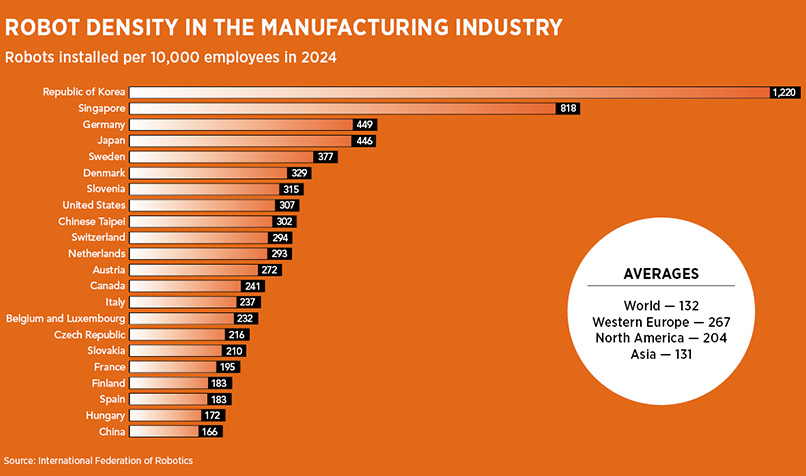
Research shows the country has some catching up to do. Australia currently has 272 robots per 10,000 workers, which is well behind countries like Korea that has 1200, or Singapore that has 818.
“To rebuild Australian manufacturing in the world of AI and robotics, we need to increase the density of the take-up of robots in industry so we can capitalise on our areas of competitive advantage and find new ones,” says University of Technology Sydney emeritus professor, Roy Green AM.
The government’s A Future Made in Australia policy, which is designed to attract private sector investment into the Australian manufacturing sector, should set the foundations to support this vision.
“The plan envisages greater sovereign capability — not to make everything in Australia, but to do so in such a way it does not make us any more vulnerable than we are at present,” Green says. “In fact, it should strengthen our self-sufficiency. Robots connected with industrial AI are a very important part of that strategy.”
5 ways to track the ROI of AI
China's robot revolution
While Australia is building robotics credentials in field and remote environments, China is pursuing an altogether different scale of ambition. In 2025, the country had more than 140 domestic humanoid robot manufacturers and released over 330 humanoid models — figures that reflect not just industrial capacity, but a wider national strategy.
Beijing has made embodied AI a centrepiece of its 15th Five-Year Plan (2026–2030), with targets including 100,000 humanoid robots deployed domestically by 2027.
Government-backed training facilities — the largest spanning more than 10,000 square metres in Shijingshan District, Beijing — are generating millions of data points annually to accelerate development. Meanwhile, price points are collapsing: Unitree’s R1 humanoid launched in mid-2025 at US$5900 (A$8527), a threshold analysts consider the commercial tipping point.
Of the more than 12,000 humanoid robots shipped in 2025, Chinese companies AgiBot and Unitree each shipped over 5000. For Australian businesses and their finance teams weighing robotics investment decisions, China’s trajectory is worth watching — not just as a competitor, but as a signal of how quickly the economics of robotics can shift.
Production credit
Banner image Andriy Onufriyenko/Moment via Getty Images