Loading component...
At a glance
Amid a budget surplus, Hong Kong’s budget 2026, delivered by financial secretary Paul Chan, focuses on strengthening economic fundamentals and supporting growth.
The key numbers from budget 2026
- The Operating Account for 2025–26, previously forecast to post a deficit of around HK$3 billion, is now expected to record a surplus of HK$51.3 billion.
- The 2025–26 revised estimate of total government revenue is about 4.5 per cent higher than originally estimated.
- The economy is forecast to grow by 2.5 to 3.5 per cent in 2026, with headline inflation expected to be 1.8 per cent.
- HK$100 million to accelerate the government’s own digital transformation.
- HK$1.6 billion investment in Hong Kong Tourism Board.
- HK$28 million in funding for the Hong Kong Technology and Innovation Support Centre.
- HK$200 million allocated for the Dedicated Fund on Branding, Upgrading and Domestic Sales (BUD Fund).
- HK$10 billion as initial capital to develop San Tin Technopole by establishing a dedicated company.
- HK$10 billion to support campus development for the Northern Metropolis University Town.
Focus areas of the 2026 Hong Kong budget
- Enhanced tax policies
- Financial sector investment
- SME support
- AI boost
With the theme of “Driving High-quality, Inclusive Growth with Innovation and Finance”, the 2026 budget is delivered as Hong Kong’s economic conditions improve amid global volatility.
Analysis of Hong Kong budget 2026
Anthony Lau FCPA (Aust.), co‑chair of CPA Australia’s Greater China Taxation Committee
“The re-domiciliation regime has begun to show positive results since its implementation in Hong Kong.
“We recommend making better use of the regime to attract overseas companies to establish or expand their operations in Hong Kong, and to step up promotion efforts to clearly explain the relevant details of the regime to businesses.
“At the same time, the government could engage with Mainland tax authorities to clarify that no Mainland tax liabilities would arise for a redomiciled corporate group with underlying Mainland entities.
“We welcome the budget’s announcement of a package of preferential policies to promote industry and investment for companies establishing operations in Hong Kong.
“The proposed measures, including land grant arrangements, financial subsidies and tax incentives — such as half-rate tax or a preferential rate of five per cent — are attractive, and would help draw more enterprises to Hong Kong and contribute to economic growth.
“We look forward to the early release of further implementation details to support effective promotion.
“To support infrastructure development, including the Northern Metropolis, we suggest issuing bonds of varying tenors to international investors.
“We also recommend providing tax exemptions on interest income and disposal gains from bonds issued by the government or private entities to finance infrastructure projects in the Northern Metropolis.”
Karina Wong FCPA (Aust.), co‑chair of CPA Australia’s Greater China Taxation Committee
“We suggest that the government consider introducing a preferential profits tax rate of 8.25 per cent for single family offices, multi‑family offices and fund managers to enhance Hong Kong’s competitiveness among regional wealth management centres.
"We support the establishment of an Advisory Committee on Tax Policy to provide a structured platform for reviewing Hong Kong’s tax system. CPA Australia has long called for a comprehensive review and research study into potential tax reform to ensure Hong Kong’s tax regime remains competitive, resilient, and fit for purpose amid evolving economic and global tax developments."
Janssen Chan FCPA (Aust.), co‑chair of CPA Australia’s Greater China Taxation Committee
“We propose reintroducing a funding scheme similar to the Technology Voucher Programme to support eligible small and medium-sized enterprises.
“The scheme could offer HK$200,000 per eligible applicant to pursue AI adoption and related training.
“As the government reviews research and development (R&D) tax arrangements to strengthen integration with the Greater Bay Area, we recommend expanding qualifying R&D expenditure to include R&D activities outsourced to GBA enterprises.”
Adam Chiu CPA (Aust.), member of CPA Australia’s Greater China Taxation Committee
“CPA Australia welcomes the government’s efforts to promote innovation and technology.
“We support the establishment of the AI+ and Industry Development Strategy Committee, which promotes the application of artificial intelligence in line with national development strategies.
“We propose increasing the Continuing Education Fund subsidy by HK$10,000, designated for AI‑related training, raising the total subsidy to HK$35,000 per eligible applicant.
“We welcome the increase in personal tax allowances, as regular adjustments can help ease cost-of-living pressures. Salaries tax allowances should be reviewed annually to better reflect inflation.
“The government may also consider extending dependent parent and grandparent allowances to retirees residing in the Greater Bay Area. This would encourage cross-boundary retirement while providing tax relief to their children/grandchildren who are taxpayers in Hong Kong.”
Tax incentives and changes

Paul Chan will establish and chair an advisory committee on tax policy to gather views from commercial, industrial and professional sectors, so that tax policy can reinforce economic development. CPA Australia supports the establishment of this committee and looks forward to engaging with it on ways to further improve Hong Kong’s highly competitive tax system.
To further attract family offices and funds to Hong Kong, the government will enhance the family office tax regime by expanding the definition of “fund” to cover specific funds of one, as well as classifying digital assets, precious metals, specified commodities and so on, as qualifying investments eligible for tax concessions.
Other important tax measures announced in the budget include:
- A reduction of salaries tax and tax under personal assessment for the year of assessment 2025–26 by 100 per cent, subject to a ceiling of HK$3000.
- A reduction in profits tax for the year of assessment 2025–26 by 100 per cent, also subject to a ceiling of HK$3000.
- Hong Kong will further expand its Comprehensive Avoidance of Double Taxation Agreements network, which CPA Australia hopes will include Australia.
- Corporate Treasury Centres and their associated companies will be offered additional tax incentives and flexibility, alongside a pre-approval mechanism. Details will be released mid-year.
- The government will seek to amend the Inland Revenue Ordinance to implement the Crypto-Asset Reporting Framework as well as amend the Common Reporting Standard.
- The government will explore offering tax incentives for eligible institutions conducting gold trading and settlement in Hong Kong.
- The government will seek to enhance tax concessions for the maritime service industry and provide a half-rate tax concession to eligible commodities traders.
Additionally, the government will consult on the trade on tax deduction arrangements for capital expenditure incurred for purchasing IP or the rights to use intellectual property (IP). There will also be a review and enhancement of tax arrangements for R&D expenditures.
Property
The government will introduce an amendment bill this year to enable the privatisation or restructuring of REITs (real estate investment trusts), and also provide a stamp duty waiver for the transfer of non-residential properties into REITs seeking to list.
The government will also:
- Facilitate the internal restructuring of enterprises by relaxing the criteria for stamp-duty relief in relation to the intra-group transfer of assets. Raise the rates of stamp duty on residential property transactions valued above HK$100 million from 4.25 per cent to 6.5 per cent.
- A rates concession for domestic properties for the first two quarters of 2026–27, subject to a ceiling of HK$500 for each rateable property.
AI and digital transformation boost
The budget will allocate HK$50 million to boost AI capability across Hong Kong. The government will invite public organisations to organise, in collaboration with technology enterprises and tertiary institutions, AI application courses, seminars and competitions targeting students, young people and members of the public.
Additionally:
- HK$100 million is allocated to introduce leading technologies to help accelerate the government’s own digital intelligence transformation.
- HK$2 billion for digital education in primary and secondary schools to offer school‑based AI education programs.
Markets
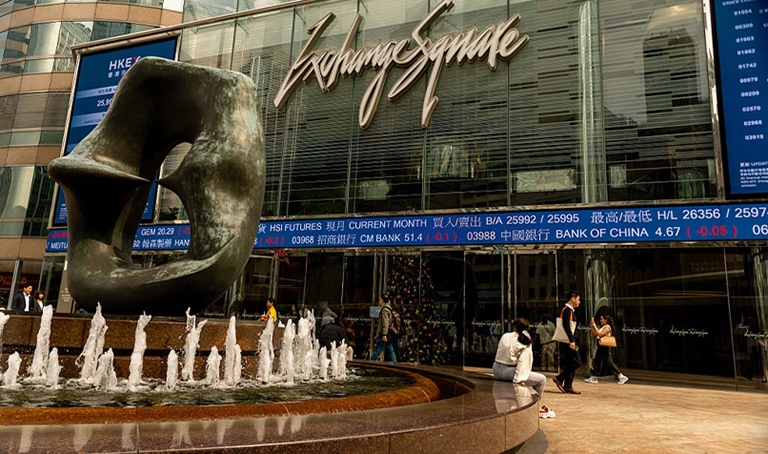
The government will continue its reforms to support the financial markets, including enhancing the regulatory regime for listed companies.
This will provide specific guidelines for overseas companies seeking secondary listing in Hong Kong, offering more overseas markets as recognised exchanges, and continuing to explore with the market the provision of an over-the-counter trading platform for delisted stocks or those requiring special handling.
The Hong Kong Monetary Authority (HKMA) will also encourage more digital bond issuances through the Digital Bond Grant Scheme.
Additionally, the HKMA's CMU OmniClear Holdings Limited and the Hong Kong Exchange will soon commence a study on the establishment of a one-stop multi-asset class, post-trade securities infrastructure to cover Mainland and Hong Kong equity and debt securities.
Future planning
Hong Kong’s Chief Executive will lead a cross-bureau, cross-departmental task force for Hong Kong to proactively align the 15th Five-Year Plan and, for the first time, to formulate a five-year strategy for the city.
SME support
The government will inject HK$200 million into the Dedicated Fun on Branding, Upgrading and Domestic Sales (BUD Fund), and raise the funding ceiling of “Easy BUD” to HK$150,000 per application. It will also provide more targeted funding support for enterprises in AI application.
The government will also launch the New Industrialisation Elite Enterprises Nurturing Scheme this year, supporting targeted high-growth enterprises that contribute to the development of new industrialisation.
In addition, it will continue to provide loan guarantees to enterprises through the SME Financing Guarantee Scheme, extending the application period for the 80 per cent guarantee product to the end of March 2028.
A cross-sectoral professional services platform will also be set up, bringing together Hong Kong's professional services providers in the field of legal services, accounting, financial services, testing and certification, and marketing, to support enterprises going global.
Sustainability reporting
With the implementation of the Hong Kong Sustainability Disclosure Standards, the Accounting and Financial Reporting Council will be consulting with the public on the proposed regulatory framework for assurance. CPA Australia will be involved in those discussions.
Infrastructure
The budget proposes, under the Exchange Fund Ordinance, to transfer HK$75 billion in each of the coming two financial years from the Exchange Fund to the Capital Works Reserve Fund in support of the Northern Metropolis and other infrastructure projects.
Furthermore, this year, the government will establish a dedicated company and seek approval from the Legislative Council to inject HK$10 billion as initial capital to take forward the San Tin Technopole development.
Social, aged and salary support
- There will be an allowance for eligible social security recipients, equal to one month of the standard rate Comprehensive Social Security Assistance payments.
- To better protect employees’ MPF benefits, the Mandatory Provident Fund Schemes Authority proposes to enhance the process of recovering default contributions from employers.
- Increasing the basic allowance and single parent allowance from HK$132,000 to HK$145,000, and the married person’s allowance from HK$264,000 to HK$290,000.
- Increasing the allowance for maintaining a dependent parent or grandparent aged 60 or above from HK$50,000 to HK$55,000.
- Increasing the allowance for maintaining a dependent parent or grandparent aged 55 to 59 from HK$25,000 to HK$27,500.
- Raising the deduction ceiling for elderly residential care expenses from HK$100,000 to HK$110,000 for taxpayers whose parents or grandparents are admitted to eligible residential care homes.
Economic performance and outlook
Overall, economic conditions are broadly positive, a view that is also reflected in CPA Australia’s recent Hong Kong Economic and Business Sentiment Survey results. Key economic data from the budget includes:
- The economy is forecast to grow by 2.5 per cent to 3.5 per cent this year.
- Hong Kong has returned to an operating surplus after three consecutive years of deficits.
- Inflation is expected to be moderately higher than last year with the underlying rate and the headline rate this year to be 1.7 per cent and 1.8 per cent respectively.
- As a result of the robust stock market and an accelerated economic growth, stamp duty and profits tax revenue is nearly HK$50 billion higher than originally estimated.
- The 2025–26 revised estimate of total government revenue is about HK$688.8 billion, representing a 4.5 per cent increase over the original estimate.
- Reflecting buoyant equity market conditions and stronger economic growth, stamp duty revenue is revised to HK$99.5 billion, an increase of approximately HK$31.9 billion from the original estimate.
- The revised estimate of total government expenditure for 2025–26 is HK$789.2 billion, which is HK$33.1 billion lower than originally estimated. Of this, recurrent expenditure is HK$572.4 billion, lower than the original estimate by HK$15.7 billion.
- The Operating Account for 2025–26, which was originally estimated to record a deficit of about HK$3 billion, will register a surplus of HK$51.3 billion.
- It is expected that the consolidated account will register a surplus of HK$2.9 billion instead of a deficit of approximately HK$67 billion as originally estimated. Fiscal reserves are expected to be HK$657.2 billion by 31 March 2026.