Loading component...
At a glance
- Ever-increasing demand for satellite services presents infrastructure opportunities in the APAC region.
- The sector’s growth has enormous flow-on benefits for the wider economy and non-space-sector businesses.
- Investment flows will be crucial to the success or failure of interstellar entrepreneurs as the race for space heats up.

As CFO of Gilmour Space Technologies, Ashley Hasforth’s workplace focus shifts more dramatically than most accountants’ — spreadsheets one day, space-launch vehicles and satellite platforms the next.
In between financial duties, he can often be found visiting rocket production lines that are at the heart of the Gold Coast business’s move to build and operate critical space infrastructure on Australian soil. Hasforth does not underestimate the privilege of the role.
“There are not many organisations where you can go to work every day and think that you are literally making history and making a difference to the world,” says Hasforth, the financial steward of an enterprise that is building sovereign space capability in Australia.
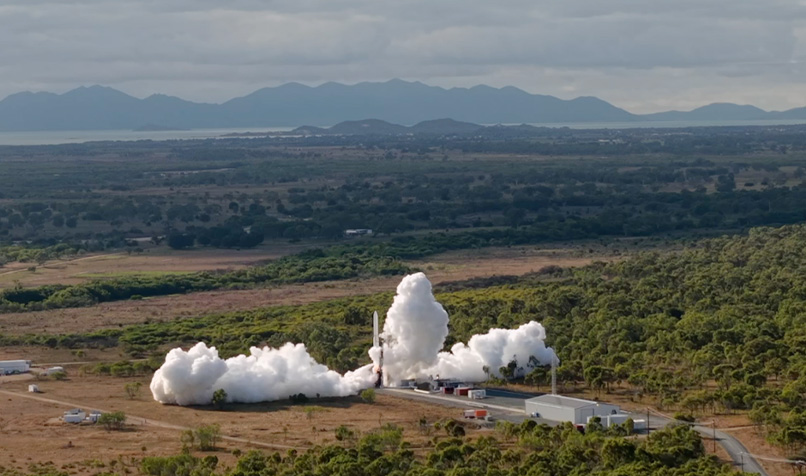
Fresh from completing the maiden test launch of Australia’s first locally designed and built orbital rocket, Eris, in North Queensland last year, Gilmour Space has secured A$231 million in private equity investment to support the next phase of growth.
The Eris project represents a breakthrough for Australia as it seeks to carve out a niche in areas including satellite manufacturing, launch services, remote sensing and space-enabled technologies.
Innovation and Creativity
The next chapter
The global space economy is expected to soar to US$1.8 trillion (A$2.61 trillion) by 2035, according to the World Economic Forum.
In Australia, the sector already generates up to A$4 billion annually, with ambitions to triple in size and create up to 20,000 more jobs by 2030. The key drivers are partnerships with NASA and the European Space Agency.
Asian nations are also lining up to play their part in the space economy. Singapore has set up a new National Space Agency (NSAS) while committing more funding to space-tech research. In Japan, Synspective is delivering near-real-time disaster monitoring via satellite constellations, while China is accelerating low-Earth-orbit satellite constellations.

Michelle Khoo is the co-leader for Deloitte’s Centre for the Edge and has played a key role in building the firm’s space practice in South-East Asia. She believes the region’s space sector is entering a more practical, commercially relevant phase of growth.
The Asia-Pacific region is projected to capture 52 per cent of the value created by Earth observation technologies in 2030, Khoo says, which is equivalent to a potential US$315 billion (A$457 billion). Across South-East Asia specifically, Deloitte estimates that increased adoption of Earth observation could contribute an additional US$100 billion (A$145 billion) to the area’s GDP by 2030.
“In this region, space is becoming an enabling layer for the wider economy, with satellite data and connectivity helping industries make better decisions in agriculture, energy, logistics, finance, public services and climate resilience.”
Khoo thinks the next wave of growth will come from the application of “space capabilities across non-space industries”. That opportunity is especially relevant in South-East Asia, where geography, rapid urbanisation, climate exposure and fragmented land and sea environments create strong demand for satellite-enabled solutions.
For the economic value of space projects to be realised, she suggests that adoption should move beyond awareness and pilot projects.
“Satellite data creates value when organisations can turn large volumes of imagery into timely, decision-ready insights and embed them into everyday operations across sectors such as insurance, infrastructure, energy, logistics and public services,” Khoo says.
“Achieving this will require more than access to raw data. It will require deployable tools, streamlined workflows, geospatial analytics talent, strong data governance, cyber resilience and the confidence to integrate these services into routine enterprise operations.”
The importance of satellites
This year, the Artemis II lunar flyby mission put space in the headlines again as the crew travelled further from Earth than any humans before, setting the stage for a scheduled landing near the Moon’s south pole in 2028. Likewise, an IPO for SpaceX and Starship V3’s successful launch in May 2026 has put interstellar activities firmly in the news.
However, space industry expert Dr Cassandra Steer, chair and founder of the Australian Centre for Space Governance, believes the more nuanced story is around the mass deployment of satellites in space. They are critical to everyday life, underpinning telecommunications, banking, navigation, agriculture, weather forecasting and disaster management.
“We would struggle to function without these capabilities,” Steer says.
"Satellite data creates value when organisations can turn large volumes of imagery into timely, decision-ready insights and embed them into everyday operations across sectors such as insurance, infrastructure, energy, logistics and public services."
While nations such as the Philippines are using satellite technology to mitigate and inform responses to natural disasters such as earthquakes, typhoons and tsunamis, she believes Australia’s current space campaign needs to be widened.
Steer says launching rockets and getting Australian astronaut Katherine Bennell-Pegg into space are worthy activities, but she advocates for greater funding and momentum on satellite capabilities. Currently, Australia relies heavily on foreign or commercial providers for satellite data needs, she says.
Steer suggests Australia should maximise its strengths in areas such as the ground and data segments of Earth observation satellite systems that monitor land, oceans and weather. “We have world-leading capabilities in Earth observation data management.”
With nations such as Japan, India, Singapore and South Korea investing in satellite constellations and manufacturing, Steer believes Australia’s proximity to these markets — combined with favourable launch locations and strong research capabilities — presents opportunities for collaboration and export.
Podcast: How satellite data improves business decisions
Funding for space initiatives
For finance professionals, the race is less about engineering milestones and more about capital allocation, governance and risk in a fast-moving ecosystem.
As Asia accelerates toward commercial space models, investment is flowing into infrastructure, data platforms and cross-border partnerships — raising new questions around regulation, cybersecurity and long-term returns. Understanding how these regional dynamics intersect with the Asia-Pacific’s region’s ambitions will be the key for those looking to engage with the next phase of the space economy.
Khoo has no doubt that funding will be critical to the continued growth of the sector. Across the region, governments are already demonstrating their commitment through significant investments. She notes that Singapore has committed more than S$200 million (A$223 million) to space tech research and development since 2022 and Vietnam’s National Space Centre has made more than US$260 million (A$376 million) in total investment.
“These efforts are complemented by larger commitments in more mature space economies, including Japan’s plan to scale its Space Strategy Fund to around US$6.6 billion (A$9.5 billion) over the next decade,” Khoo says. She adds that private investment will flow fastest where commercial value is clear and proven.
"[The space industry] is no longer thought of as a kind of science project — it is now a mainstream industry and the world knows that civilisation as it is today would not survive without it."
The most investment-friendly opportunities will be those that demonstrate measurable improvements in resilience, compliance, underwriting, efficiency or decision-making speed, “supported by strong proof points, recurring demand and scalable business models. The region now has a clear opportunity to connect technology, capital, translates into practical economic value for businesses and society.”
Securing funding for space initiatives from government or private sectors can be painstaking, but Hasforth says the recent SpaceX IPO has put the space industry up in lights for investors.
“It is no longer thought of as a kind of science project — it is now a mainstream industry and the world knows that civilisation as it is today would not survive without it.”
Hasforth says striking the right balance between exciting space-related projects and prudent financing is crucial in his role. Although space engineers typically “like everything to be gold plated”, he believes establishing robust financial strategies in tandem with co-founder Adam Gilmour has given Gilmour Space a competitive edge.
“It has certainly set us apart from a lot of the other companies in the industry that have fallen away purely from a lack of cost management and prudent management of finances, budgeting and forecasting.”
A strategic imperative
As reliance on space-based services continues to grow, investment in the sector is increasingly being viewed not only as an economic opportunity, but as a strategic imperative.
In this regard, Singapore’s new national space agency is a timely and strategic move. However, its biggest opportunity, according to Khoo, lies in accelerating enterprise demand for satellite data and services — a key driver of industry growth.
“As a pro‑business, pro‑innovation agency, its success will depend on how effectively it unlocks commercial adoption. As a dedicated national platform, NSAS strengthens Singapore’s ability to engage internationally and help shape emerging norms in space, even as it builds credibility in a complex global environment.”
She says it also builds on Singapore’s strengths in regulation, cybersecurity and governance, supporting critical functions such as space traffic management and domain awareness.
As Australia pursues the benefits of space initiatives, Hasforth urges governments to back innovators, including through awarding government defence contracts to local companies. This will help to keep profits, intellectual property, tax revenue, strategic control and decision-making in Australia, “as opposed to going directly overseas as the first port of call,” he says. “That is where we need to work to try to get the government to support industry more.”
Steer argues that Australian space activities also need more support from angel investors and venture capitalists. She says a positive upshot of SpaceX being in the headlines is that it is shifting attention to why space is so highly valued. “It is not just about SpaceX launching things — it is all of the services that come from space.”
As the benefits of interstellar initiatives have more of an impact on the wider economy, Steer hopes more venture capitalists and Asian investors will be willing to fund the Australian companies that are doing valuable work.
Hasforth is confident that Gilmour Space will be one of the key Australian players in a thriving market as it collaborates with space leaders, including Japan and South Korea. The business wants to help fill the gap between the huge demand for satellites and the simultaneous lack of launch vehicles.
He cites Commercial Space Federation research predicting that up to 7000 launches will be required in a single year by the mid-2030s, yet just over 320 launch attempts occurred in 2025.
“So,” Hasforth says, “we see a huge market ahead of us”.
Production credit
Banner image Max Dannenbaum/The Image Bank via Getty Images