Managed accounts: Weighing the benefits, risks and regulation


Loading component...
At a glance
- Managed accounts are becoming the preferred portfolio solution for advisers due to efficiency, transparency and professional oversight.
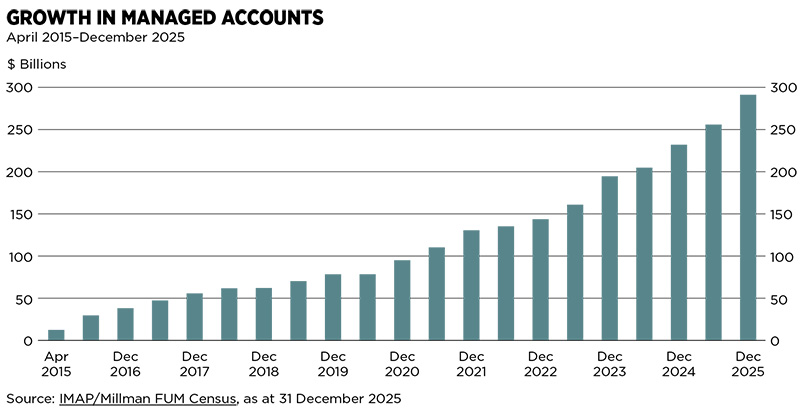
- Strong growth continues, with funds under management nearing A$300 billion in Australia and adoption rising across advice practices.
- ASIC is scrutinising the sector, focusing on conflicts of interest, challenges and how they are being managed as usage expands.
Financial advisers across Australia are increasingly using managed accounts to build and manage investment portfolios for their clients. There are several reasons for this. Many advisers prefer them because they provide an efficient way to give clients access to a range of professionally managed, low-cost model portfolios offered by different fund and asset managers.
For clients, key benefits include directly owning all the underlying securities inside their personal managed account, which ultimately gives them greater portfolio transparency and investment flexibility.
Most importantly, because they generally sit within a professional portfolio management regime, managed accounts can potentially provide greater consistency and discipline in portfolio construction and management than those managed on an ad hoc basis by individual advisers.
Clients can customise their portfolios, for example, by excluding certain companies or sectors, aligning their investments with their ethical preferences or adjusting them to meet their personal financial needs.
At the same time, investors can avoid capital gains tax issues that generally come with investing in pooled retail investment funds, where investors may inherit the unrealized capital gains positions of other investors. In a managed account, investors have better control over the timing of when they realise capital gains and losses to improve tax efficiency.
Richard Webb, CPA Australia’s superannuation lead, says that managed accounts can be a good solution for those seeking access to top investment professionals.
“If you have the money to invest in a managed account, you can still get access to professional investment expertise and bypass a fund’s inherited capital gains tax issues,” Webb says.
For most advisers, the preference is to use separately managed account (SMA) products readily available on external investment platforms that offer access to a broad menu of investment options.
The other, less commonly used structure is the managed discretionary account (MDA). Like SMAs, investors can access a broad range of investment options and still own the underlying securities. They also give licensed providers the discretionary authority to make investment decisions, including trades, on behalf of their clients within an agreed investment program.
6 trends shaping management accounting in 2026
An evolving growth story
Recent research published by State Street Investment Management and Investment Trends notes that more than 60 per cent of Australian advisers are now using managed account products.
“Managed accounts continue to reshape the way financial advice is delivered in Australia,” says State Street’s model portfolio strategist, Sinead Schaffer. “What began as a specialist portfolio implementation tool has evolved into a core operating framework for many advice practices, supporting better client outcomes, stronger governance and more scalable business models.”
Just how popular managed accounts have become is evident from the massive growth in funds under management (FUM) in SMAs and MDAs. According to data from the Institute of Managed Account Professionals (IMAP) and Milliman, managed account FUM totalled A$30.8 billion a decade ago.
By the end of 2019, it had grown to A$79.3 billion. Over the course of 2025, managed account FUM rose to A$292.9 billion.
IMAP’s chair, Toby Potter, describes the Australian managed accounts market as being in the maturity phase. “One of the things managed accounts have done, as funds under management have grown towards the current amount, is create opportunities for organisations to provide portfolio management services that did not exist before.
"Across all financial advisers, 31 per cent of new inflows are going into a managed account structure. We also track adoption rates: 61 per cent of advisers are now using managed accounts, another 13 per cent are considering them and a fairly stable 18–19 per cent are not users."
“The market has seen the entry of very large organisations like BlackRock, Vanguard and Betashares at the passive, ETF-based end of managed accounts. Research houses like Morningstar have become major participants, and Evidentia is now the largest portfolio manager in the managed account space,” he says.
“You also have portfolio management businesses that have grown out of advice businesses. And, of course, asset consultants that previously served institutional clients are increasingly significant participants in the managed account market, particularly JANA, Russell Investments and Mercer.”

Paul McGivern CPA, finance and research director at Investment Trends, says managed accounts have become the dominant portfolio implementation structure, especially among new advisers and for new client inflows. “Growth is shifting from adoption to optimisation, and competition is intensifying across platforms and investment managers beyond just pricing.
“Across all financial advisers, 31 per cent of new inflows are going into a managed account structure,” he says. “We also track adoption rates: 61 per cent of advisers are now using managed accounts, another 13 per cent are considering them and a fairly stable 18–19 per cent are not users.
That non-user group has remained steady for the last four years, largely because of the types of clients they work with or the advice models they use.”
Benefits for advisers
For advisers, another key benefit of using managed accounts is that they can help manage multiple client portfolios at scale while still allowing individual tailoring. Modern investment platforms make it easier to administer investment accounts, link them to super or pension accounts, and automate client reporting.

Shadforth Financial Group adviser, Bruce Mackley CPA, notes that one of the biggest reasons his firm uses MDAs is for compliance. He points out that advice documentation requirements differ because clients have given full trading authority to their independent investment team.
“It creates efficiency to make investment moves without delaying things when clients have to sign off each time there is an investment change,” Mackley says.
He adds that a major benefit of managed accounts for time-poor advisers is the efficiency of having client accounts reviewed by a separate investment manager, whether managing one client portfolio or many, based on their philosophy and the client’s goals.
“That is probably a big part of it as well — it also allows advisers to focus on advice rather than, for example, being stock pickers. Instead, we leave those investment decisions to professionals whose bread and butter is making those changes for clients,” Mackley says. “That is probably why a lot of advisers are utilising a discretionary service, whether it is an SMA or an MDA.”
Under the ASIC Corporations (Managed Discretionary Account Services) Instrument 2016/968, MDA providers receive conditional relief from certain provisions of the Corporations Act 2001, including some managed investment scheme and disclosure requirements.
Among other things, advisers can recommend MDAs without triggering managed investment scheme obligations that require structures to have a responsible entity, a product disclosure statement, a constitution and compliance plan, and for assets to be held by a custodian.
ASIC raises concerns
The rapid growth of the managed accounts sector has not escaped ASIC’s attention. Among other things, it is examining whether licensees and advisers who recommend or offer managed accounts are meeting their obligations to act in the best interests of their clients.
This includes examining whether conflicts of interest may arise, such as where an advice practice or adviser receives incentives from licensees for recommending clients into specific managed account products.
“In light of substantial growth in the SMA sector in the past five years, ASIC is interested in what is driving these changes, what the impacts are, how different incentives might influence these changes, and, most importantly, what they mean for consumers,” says ASIC commissioner Alan Kirkland.
"It also allows advisers to focus on advice rather than, for example, being stock pickers. Instead, we leave those investment decisions to professionals whose bread and butter is making those changes for clients."
“ASIC is also looking at what conflicts may arise, what challenges they may present and how they are being managed,” he continues, adding that the corporate regulator aims to publish findings by the end of 2026 “following a review that includes an analysis of products and financial advice”.
Potter notes that ASIC appears to be concerned about perceived conflicts when an advice firm is also involved in the portfolio-management process.
“That appears to have been the focus of its inquiries, although I am sure it has also looked at other issues such as resourcing and advice groups’ preferences for particular types of SMAs,” Potter says. “That focus on conflicts of interest does not appear to have been extended to MDAs, but in due course it probably will.”
What accountants can do
Irrespective of ASIC’s findings, the managed accounts market is well entrenched and here to stay.
For an accounting practice wanting to use managed accounts, if they have a financial planning arm, the question is which managed account structure (SMAs or MDAs) is most appropriate.
“If you have a cohort of clients who are lower-value accumulators or in a pension phase, then a straightforward SMA product from the platform of your choice is likely to be suitable,” Potter says. “If you have a more complex client base — business owners, higher-value clients or clients who want asset-protection structures — but you still want professional portfolio management capability, then an MDA is likely to be more appropriate.”
As managed accounts continue their rapid expansion and become a central pillar of Australia’s advice landscape, they are likely to remain an enduring feature of modern advice and a strategic choice that will shape how firms deliver value in the years ahead.
How much super do you need to retire in Australia?
Understanding managed account fees
Managed accounts offer clients greater investment transparency, but the layers of fees applied to the products incorporated into accounts are not necessarily readily understood.
Managed account fees can vary by platform, manager and structure, and are typically charged in addition to financial advice fees. For example, investment management and trading fees may be charged by portfolio managers for constructing and maintaining the structure of investment product models. Some may also apply investment performance fees.
Many managed accounts use exchange traded funds or managed funds as core portfolio building blocks. Each of these components has its own management costs. Platform and administration fees are also applied to cover things such as custody, reporting, tax statements and infrastructure.
Paul McGivern CPA, finance and research director at Investment Trends, says platforms are the primary point of access to managed accounts, with some advisers viewing their fee structures as too expensive, which he says is one reason for non-adoption.
Industry research and services group Adviser Ratings says platforms, investment managers and SMA managers vary in their approach, creating different rules and descriptions for disclosing fees and asset allocations. Descriptions across platforms for identical SMAs are also not always consistent.
Toby Potter, chair at IMAP, says the typical fee structure in an SMA is a single fee that rolls up the portfolio management process and the responsible entity’s cost of providing the product.
“In the managed discretionary account space, fee structures can be more complicated because advice fees, portfolio management fees and administration fees are sometimes rolled into one aggregate number and sometimes separated.”
Following an industry forum in late 2025, Adviser Ratings launched the SMA Reporting Standard to create a consistent fee-reporting framework for SMAs.
“The SMA Reporting Standard streamlines fee reporting by standardising data fields that are already part of SMA construction and management,” Adviser Ratings states. “It ensures that consumers and advisers can easily compare identical SMAs across platforms, fostering clarity and trust in the industry.”
Production credit
Banner image maphke via Getty Images