Planetary intelligence: Why it's key for climate decision-making


Loading component...
At a glance
- As climate risks grow, integrated environmental data is becoming essential for better decision-making.
- The rise of AI-powered systems is increasing the need for strong governance, assurance and financial oversight.
- CSIRO’s Spark system shows how AI-driven planetary intelligence can help predict bushfire behaviour.
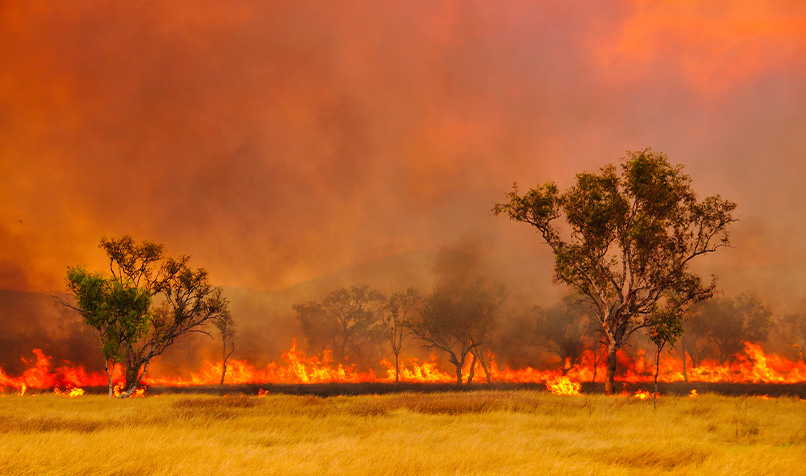
This past summer, in Australia, a new and increasingly critical example of advanced fire intelligence was used for the first time. Capable of simulating around 10 to 15 kilometres of fire-front movement in roughly 30 seconds, a newly developed system that had been years in the making allowed emergency teams to rapidly test different scenarios as bushfire conditions shifted on the ground.
For a country facing increasingly severe fire seasons that have killed dozens of people, destroyed thousands of homes and generated multi-billion-dollar economic costs, these capabilities are becoming ever more significant.
Embedded in operational settings by emergency management agencies, CSIRO's Spark bushfire modelling system supports real-time fire-spread modelling and response planning across active incidents.
It is an example of the concept of “planetary intelligence” — or how artificial intelligence (AI) is beginning to bring together vast and previously fragmented streams of environmental data into usable, real-time decision support.
By combining multiple inputs and modelling how they interact, the system can project both the speed and intensity of a fire front, says Dr Mahesh Prakash, senior principal research scientist at CSIRO.
“We pull in direct weather feeds from the Bureau of Meteorology, which allows emergency management agencies to respond more tactically to emerging scenarios,” he says. “That helps agencies assess which fires are likely to be most destructive, and where to focus resources when there are multiple incidents happening at once.”
Beyond individual incidents, the same challenge — making sense of complex, interconnected systems fast enough to act on them — is playing out across weather, agriculture, energy, ecosystems and financial markets.
As global warming intensifies, the challenge is no longer recognising that these systems are interconnected but developing the capacity to interpret those relationships fast enough to manage escalating risk.

AI is the key to unlocking that capacity, argues Tim Timchur FCPA, chair of the CPA Australia environmental, social and governance (ESG) Centre of Excellence and managing director of 365 Architects.
“By processing these fragmented streams of data in real time, it can start to stitch together a more unified picture of the planet, which is pretty exciting,” says Timchur. “Planetary intelligence is the concept of moving from simply describing the planet to helping us manage it.
While we can now collect unprecedented volumes of environmental data, the challenge is increasingly about integrating and making sense of that information in real time across fragmented systems.”
For businesses, the appeal is obvious. Planetary intelligence offers a way to sharpen risk management, improve ESG reporting and strengthen operational decisions from supply chains to climate risk forecasting, he says.
From an accounting perspective, it also raises familiar questions in a new context: assurance over data and models, clarity about decision rights and confidence that AI-driven decisions stay within defined risk appetites.
“These are exactly the kinds of things accountants already deal with every day,” Timchur says, “which puts us front and centre of the issue.”
Using the data

CSIRO’s Spark model is just one example of how integrating data can help with decision-making.
Vast quantities of environmental, economic and operational information are constantly being collected across the planet. Satellites monitor land use and emissions. Sensors track soil moisture, ocean temperatures and energy consumption.
Governments compile agricultural and disaster-response data, while corporations generate increasingly detailed supply chain and climate disclosures.
Indonesia is using planetary intelligence to monitor deforestation in near real time, combining satellite imagery, geolocation data and AI to detect forest loss as it happens. Updated alerts are issued every two weeks, enabling faster intervention than traditional reporting systems, which often lag by months.
The impact has been significant, with fire-affected forest area reportedly falling from 376,805 hectares in 2024 to 213,984 hectares in 2025, suggesting that faster detection and response can materially change outcomes on the ground.
"Planetary intelligence is the concept of moving from simply describing the planet to helping us manage it. While we can now collect unprecedented volumes of environmental data, the challenge is increasingly about integrating and making sense of that information in real time across fragmented systems."
Projects such as NASA Harvest also integrate satellite imagery, weather data and agricultural models to estimate crop yields before harvest. These systems can identify drought stress, planting patterns and expected output in advance, helping to anticipate shortages and stabilise food supply chains.
Insurance companies and urban planners are also now using integrated climate-risk platforms that combine flood models, sea-level-rise projections and infrastructure data. These systems help identify which assets or regions are most exposed over time, thereby shaping investment decisions and insurance pricing.
But even as these datasets expand, integration across systems remains uneven. Dr Eva-Marie Muller-Stuler, founder and chief AI officer at Hummingbird Group, argues that the scale and complexity of the data being used in these applications introduces its own constraints.
“Satellite data is vast, complex and expensive to process,” she says. “It requires robust pipelines to clean, structure and interpret information before it can be used meaningfully.”
This challenge becomes more acute in real-world deployment, where systems need to move beyond analysis into verified decision-making.
Biodiversity loss: A guide for today's finance leaders
Monitoring the data
Even the most advanced systems still depend on “ground truthing” or verifying that what the model sees matches what is happening on the ground. This process can involve drones, field surveys or other forms of physical verification, all of which are slow and expensive.
For systems that already use AI to bring data together, a key requirement is ensuring that model outputs remain reliable when tested against real-world conditions, says Prakash. “We test the outputs from Spark against more than a dozen historical datasets where we have reliable records, and we constantly update the model to make sure it is performing as expected.”
Rather than relying on a single forecast, the system is designed to generate a range of possible outcomes.
“We never run one simulation. We run hundreds of simulations so that it gives a range of outcomes,” says Prakash. “Emergency managers then look at that spread — the best case and the worst case — and use it to make informed decisions.”
However, as systems become more complex and embedded in real-time decision-making, validation alone is not enough. It also raises questions of assurance and the need for clear guardrails around how AI systems are built, trained and monitored.
Without them, systems that are not trustworthy can create systemic risk for every organisation that relies on them, says Muller-Stuler. “This is a natural domain for the accounting and audit profession, which has long been responsible for testing systems, verifying controls and providing assurance over complex, high-stakes information environments.”
"It is about assessing the impact of both physical and transition risk associated with climate on the organisation. That starts with a more fundamental rethinking of value."
The challenge is becoming increasingly technical, she continues, which creates a capability gap.
“Effective AI assurance requires more than procedural audit knowledge; it requires a deep understanding of how models are built, how data flows through them and where risk emerges in practice,” she says. “Many audit and assurance functions do not have sufficient depth of technical AI expertise to fully interrogate model design, data integrity and risk behaviour.
This becomes particularly important as organisations come under pressure and may be tempted to cut corners, whether in data monitoring, model testing or controls designed to detect drift, leakage or failure modes.”
This challenge is compounded by a broader tendency to overestimate what these systems can deliver in practice, and how quickly they can be scaled. While AI models can appear powerful in controlled environments, expectations are often ahead of what it will look like in the real world.
The complexity is not in building a model itself, but in ensuring the data is fit for purpose, continuously updated and properly governed over time, says Muller-Stuler.
“Even well-designed systems are vulnerable to shifts in real-world conditions. Changes in customer behaviour, market structure or external inputs from commodity prices to demographic shifts, can quickly make training data obsolete.”
There is also a recurring pattern of overconfidence in data quality across most industries, she says. “There is an assumption that systems can simply be built and left to run. In reality, data is dynamic, and model performance depends on continuous monitoring and adjustment.”
Planetary data in reality
If planetary intelligence is beginning to change how governments and emergency services respond to environmental risk, the next test may be whether it can be translated into financial decision-making with the same level of rigour.

For Patrick Viljoen FCPA, ESG lead at CPA Australia, the role of the accountant becomes more important as environmental data becomes more prominent. He believes that accountants are uniquely placed to apply financial rigour to what can otherwise remain abstract, turning environmental data into something tangible, comparable and actionable.
“It is about assessing the impact of both physical and transition risk associated with climate on the organisation,” he says. “That starts with a more fundamental rethinking of value.”
Nature, Viljoen suggests, is not external to the economy but embedded within it.
“In sectors such as pharmaceuticals, for example, natural inputs remain essential to drug development and antibiotics. Yet these dependencies are rarely priced or fully accounted for in financial terms.”
The task for accountants is to translate conceptual thinking into financial terms, assigning real economic value to externalities so they can be properly weighed in decision-making.
“Aspiration in the absence of that level of financial rigour has got the potential to go horribly wrong,” he says.
That discipline is also essential because organisations do not operate with unlimited resources. Environmental decisions must sit within the broader “totality of risk” faced by a business, ensuring capital is allocated in a way that is both resilient and fit for purpose.
Accountants are already familiar with this kind of balancing act — whether through solvency risk, provisioning or capital allocation decisions, which are directly relevant to the climate transition.
Underlying all of this, Viljoen suggests, is a growing tension between expanding environmental data and the discipline required to interpret it. As reporting becomes more comprehensive, organisations are increasingly confronted not with a lack of information, but with the challenge of making it coherent, comparable and useful in decisions.
The more the planet becomes legible through data, the more essential it becomes to ensure that what is measured is not only technologically possible, but financially and ethically sound.
“We are already used to translating intangible concepts, such as reputational risk or goodwill, into financial language,” says Viljoen. “The next step is extending that logic to environmental externalities and nature-based dependencies.”