How to balance AI innovation with ethics (expert-led insight)


Loading component...
At a glance
- As AI reshapes accounting, professionals must balance its benefits with ethical responsibilities, guided by longstanding codes of conduct.
- The profession requires a balance between prescriptive rules and principle-based standards in order to address emerging AI challenges.
- Strong organisational culture, open dialogue and leadership commitment to values are essential for ethical decision-making in an AI-driven future.
Accountants constantly face ethical questions, but the rise of artificial intelligence (AI) has compelled them to ensure business technology is used in a fair, safe and responsible way like never before.
As AI has increasingly taken on more routine tasks, the need to provide the right ethical and technical training to accounting graduates has become paramount. It is important for them to harness the technology’s incredible potential, while balancing the ethical challenges the profession is facing with the benefits AI can provide.
Accountants are valued for their measured, clear perspective. Yet, the profession is having its values and purpose tested by this rapidly evolving technology.
“People expect accountants to uphold the right values in society,” said Canva strategy and operations manager, Matthew D’Cruz CPA, at CPA Australia’s recent “What will we value?” ethics and purpose roundtable in Sydney. “We need to stay true to those values, but also be flexible with the changing times.”
Prescriptive vs principled standards

Accounting has a solid bedrock of infrastructure, its professional codes of conduct wrought over many decades, to guide the way through AI’s evolving ethical challenges. CPA Australia members must comply with the Accounting Professional and Ethical Standards Board’s Code of Ethics for Professional Accountants, which runs into the hundreds of pages.
This document stipulates that accountants must adhere to five fundamental principles: integrity, objectivity, professional competence and due care, confidentiality and professional behaviour. It is based on The International Ethics Standards Board for Accountants’ standards and includes Australian definitions, which apply to all Australian members whether in business or public practice.
At the ethical juncture that professions face with AI, there is a tipping point between prescriptive and principled standards and codes. Prescriptive rules can place too much emphasis on the detail, while principled standards can lack clarity and certainty.
Also at the roundtable, CPA Australia regulation and professional standards lead Belinda Zohrab noted that the pendulum has swung toward more extensive, prescriptive settings.
“High-level, principle-based standards can be applied to a variety of circumstances and have longevity, but principles may create ambiguity and confusion,” she said. “We have come from something aspirational that can be moulded and applied positively and negatively to something which is many pages and is quite prescriptive.
“Sometimes that provides clarity and a useful argument between black and white, but it is a lot to handle.”
Another consideration is the equilibrium between rewarding accountants who follow the rules and penalising those who do not.
“We go through periods where the principle-based approach seems to work well,” commented Wayne Stokes FCPA, non-executive director at Port Authority of New South Wales and chair of CPA Australia’s Ethics and Professional Standards Centre of Excellence.
“Then, a scenario happens, such as the issues examined by the Financial Services Royal Commission, where all of a sudden the ‘stick’ needs to have a place. Therefore, you need both the carrot [reward] and stick [penalty].
“It is like a seesaw. Sometimes the swing between the carrot and the stick is balanced, and at other times it seems top-heavy, with not enough weight on one side.”
The inherent scope principle-based ethical codes may be an advantage as the accounting profession works through parameters around AI. “Principle-based thinking is beneficial because we do not know what is going to happen in the future, but we do have a set of principles we can apply,” said D’Cruz.
Whether the existing regulations and conduct codes are adequate for the coming AI revolution is unclear, but it will be incumbent upon professionals to keep abreast of any changes and adapt to them.
“Regulation is a continuous learning journey for professionals,” said Marsha Ma CPA, financial controller at Australian Energy Market Commission and a member of CPA Australia’s NSW divisional council. “It is essential, particularly given the growing complexity of modern businesses.”
Culture is key

While industry guardrails provide structure, it is a culture of open communication within organisations that ultimately supports sound ethical decision-making. Within this is an inherent appreciation for the value different perspectives and backgrounds bring.
“That’s the value of diversity”, said Max Yatsuzuka CPA, senior accountant at professional services firm Forvis Mazars. “Everyone is open to listen and really discuss, on the ground, the values of the company. Everyone is on the same level, and we ensure everyone feels free to speak and discuss together.”
As businesses implement AI across their organisations, a commitment to sound ethics from leadership is vital, because people follow by example.
“At Canva, we have a simple yet ambitious two-step plan,” said D’Cruz. “Step one is to build one of the world’s most valuable companies, and step two is to use that success to do the most good that we can. One of our values is ‘be a good human’, and we put this into practice with everything we do across the business.”
Ethics is an especially pertinent area for Canva, as it needs to comply with many international rules and regulations. Plus, the nature of its platform means minors can use its products and services, which adds complexity around governance.
“We have a code of conduct for our global organisation, but we always focus on the values,” D’Cruz explained. “We want to make sure people follow the values of integrity and honesty all the time. If anything comes to your attention, you have to always think about the values, rather than the pages the rules are on.”
Living the values
Today, organisations are much more likely to encourage accountants to be actively involved in ethical discussions.
“Accountants are at the table. What we do matters,” said CPA Australia’s head of professional standards, Melissa Read FCPA. “We are involved in the decision-making and the operation of economies and markets.
“There has also been greater awareness of the significance of ethical fundamentals over the past 25 years. When I meet with practitioners now, they are not so concerned with what the code is or what that means for them. It is about making sure that there is an ability and freedom within their staff to be talking about ethics or raising and escalating issues instead of sitting on them.”
This represents a change from a more traditional, hierarchical approach. “We are all in this together and we all represent the profession,” Read said.
An ethical education

The nexus between ethics and AI is in sharp focus for accountants as organisations more extensively report carbon dioxide emissions, due to the reliance on third-party information in reporting Scope 3 indirect emissions.
In such situations, the reporter relies on the supplier to be honest about the energy information it provides — for example, in the amount of energy that goes into making an essential piece of equipment supplied by a third party.
AI can play a role verifying that information, but technology can only do so much when it comes to confirming the ethical actions of humans. This is one reason why Ben Tse CPA, product manager at Steadfast Group, believes ethical training should start well before accountants take up their first role.
“Teaching people to be ethical has to start in primary school,” he said.
Ultimately, accountants must be able to influence stakeholders to provide the correct information. Industry bodies also have a role to play.
“We need to figure out reporting and the right tools and processes, with industry bodies supporting training and providing networks of people or experts to share their knowledge,” said D’Cruz.
Consequently, there is an opportunity to explore the interplay between ethics as it relates to climate change and climate change accounting at an undergraduate level.
“Universities are trying to catch up really quickly in the ethics space and it is evolving,” said Stokes. “I think organisations need the skill set now; otherwise, there will be issues around assurance. Ethics will always have inherent societal evolution risks.”
AI and trust
The accounting profession is still sorting through the ethics of AI’s application, the boundaries of which will continue to evolve as the technology matures. At the heart of the issue is trust — how much confidence should be placed in AI outputs and how much oversight it needs.
“You always need that element of professional judgement when reviewing work,” said Maggie Lo CPA, financial operations manager at Employment Hero.
Yatsuzuka agrees. “At the end of the day it is our advice, not the AI’s advice. So we have to ensure we put all our resources into really getting on top of it. If you cannot add anything additional to the output, then why are you charging? For us, it is a really challenging time, but it is exciting.
AI helps to improve audit in general, but do not trust the AI to do the entire check. Balance that technology component with your responsibility as a professional.”
Using AI for routine accounting tasks like safeguarding confidentiality and signing off activities carries considerable risks, in large part due to the technology’s lack of transparency, which heightens the need for ethical oversight.
“The question of ethics comes down to the AI models,” said D’Cruz. “They can often be a black box and we do not have control of what the model initially spits out, although we can heavily review and vet this output before the user sees it.”
A large language model (LLM) is a type of AI, such as ChatGPT. LLMs draw on banks of information to create content. What is material when it comes to this technology is how the information an LLM produces is used within a business.
“Our boundaries with AI are very much related to our values, so we have to make sure it is not hallucinating and vet and train all our models to make sure they output the right data,” D’Cruz added. “We have hundreds of AI researchers, scientists, machine learning engineers and data scientists globally researching and reviewing the model outputs.”
Humans remain essential
As it stands, AI is not a flawless technology — humans are still required to provide substantial oversight. Yatsuzuka believes this will continue. “In my view of the future, the humans still need to be there,” he said.
“In a hundred years’ time, CPAs might be doing different things but there will still be a system working for the general public.”
Generative AI in business: How to navigate the ethics
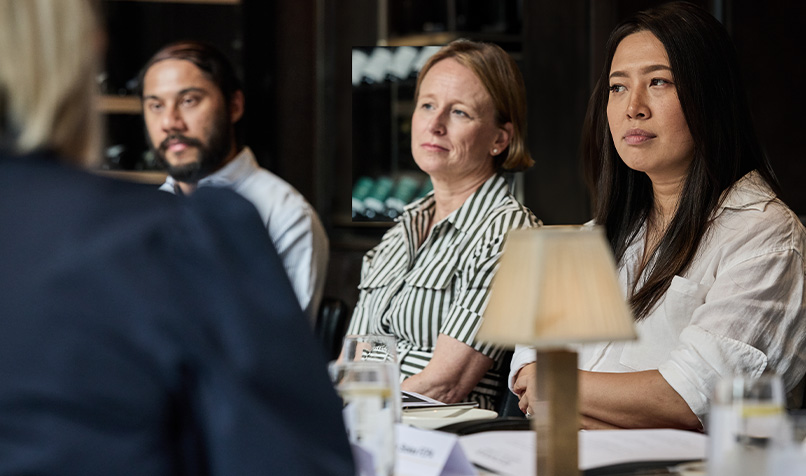
"What will we value?" roundtable attendees
- Wayne Stokes FCPA, non-executive director at Port Authority of New South Wales and chair of CPA Australia’s Ethics and Professional Standards Centre of Excellence
- Marsha Ma CPA, financial controller at Australian Energy Market Commission and a member of CPA Australia’s NSW divisional council
- Matthew D’Cruz CPA, strategy and operations manager at Canva
- Belinda Zohrab, regulations and standards lead at CPA Australia
- Maggie Lo CPA, financial operations manager at Employment Hero
- Melissa Read FCPA, head of professional standards at CPA Australia
- Benjamin Tse CPA, product manager at Steadfast Group
- Max Yatsuzuka CPA, senior accountant at Forvis Mazars
- Alexandra Cain, journalist
- Tahn Sharpe, INTHEBLACK editor at CPA Australia (host)